Business Studies ‘A’ level

General Introduction

Distance learning homepage  back to the Oxford Open Learning home page  Distance learning homepage

Welcome to your ‘A’ level Business Studies course. This Introduction should provide you with all the information you need to make a successful start to your studies.

The Specification (or Syllabus)

This course has been designed to give you a full and thorough preparation for the AS level or A level Business Studies specification, set by the Assessment and Qualifications Alliance (AQA). The specification gives you two options at A2: with or without coursework. This course pack is designed for students who are not doing coursework

The Subject Code for entry to the AS only award is 5131.

The Subject Code for entry to the A level award is 6131.

Private Candidates

The AQA specification is open to private candidates. Private candidates should contact AQA for a copy of ‘Information for Private Candidates’.

Arrangement of Lessons

Part 1: AS Level

Module One: Marketing and Accounting and Finance

    1. Business Studies
    2. Market Analysis
    3. Marketing Strategy
    4. Marketing Planning Test A
    5. Costs, Profit, Contribution and Break-even Analysis
    6. Company Accounts
    7. Budgeting
    8. Cost Centres and Profit Centres Test B

Module Two: People and Operations Management

    1. Management Structure and Organisation
    2. Motivation
    3. Human Resource Management Test C
    4. Productive Efficiency
    5. Controlling Operations
    6. Lean Production Test D

Module Three: External Influences and Objectives and Strategy

    1. Economic Influences
    2. Governmental Opportunities and Constraints
    3. Social and Other Opportunities and Constraints Test E
    4. Starting a Small Firm
    5. Business Objectives
    6. Business Strategy Test F

Part 2: A2 Level

Module Four: Marketing and Accounting and Finance (2)

    1. Market Analysis
    2. Marketing Strategy
    3. Marketing Planning Test G
    4. Company Accounts Test H
    5. Ratio Analysis
    6. Contribution and Break-even Theory
    7. Investment Decision-making Test 

Module Five: People and Operations Management (2)

    1. Communication
    2. Employer/Employee Relations
    3. Human Resource Management Test J
    4. Productive Efficiency
    5. Controlling Operations
    6. Facilities

Module Six: External Influences and Objectives and Strategy (2)

    1. Economic Opportunities and Constraints Test K
    2. Governmental Opportunities and Constraints
    3. Social and Other Opportunities and Constraints
    4. Impact on Firms of a Change in Size Test L
    5. Business Objectives Test M
    6. Business Strategy
    7. Examination Papers Tests N-P


Textbook

The course has been prepared in conjunction with an excellent textbook:

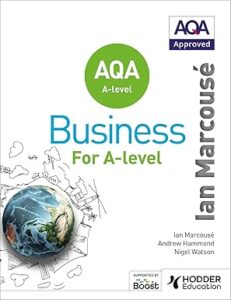
Ian Marcousé (with Andrew Gillespie, Barry Martin, Malcolm Surridge and Nancy Wall): Business Studies

Hodder and Stoughton, 1st ed; ISBN: 0-340-70462-4

Make sure you acquire this book to support your studies. One easy way of acquiring accompanying textbooks is through this website. Marcousé’s book has been written with the AQA ‘A’ level syllabus in mind and you will find that it supplements the reading and exercises required by this course.

As you work through the lessons, you will be asked to refer to Marcousé for additional information and exercises. Directions for reading will be found both on the first page of each lesson and within the lesson itself. These readings are important for a full understanding of the course, as the lessons do not repeat ideas which have been satisfactorily covered in both books.

The Marcousé exercises are for self-assessment and should not be sent to your tutor. You can check your answers by referring to the unit that precedes each set of questions, although you could consider purchasing the Teachers’ Book that accompanies the textbook. This is primarily intended to give teachers guidance on delivering and assessing the course but also contains comprehensive answers to all the exercises. (Ian Marcousé ed.: Business Studies: Teachers’ Book, Hodder and Stoughton, 1st ed; ISBN: 0-340-73763-8)

Supplementary Reading

It is important that you should get into the habit of reading as widely as possible. Get to know the business studies section in your local library and keep an eye on the business and financial sections of the daily press.

The following book is a good supplement to Business Studies:

Lines, Marcousé and Martin, Complete A-Z Business Studies Handbook (Hodder and Stoughton, 3rd edition)

The following books would be especially helpful with specific sections of the course:

Charles Handy, Understanding Organizations (Penguin, 4th ed.)

Philip Kotler, Marketing Management Prentice-Hall, 5th edition)

Claude Hitching & Derek Stone, Understand Accounting! (Pitman)

Many of the available textbooks are too technical and complex for your needs. Find ones which you can read comfortably. On the other hand, there are a large number of badly-written books about business, mostly for those who dream about making a fast buck rather than passing an examination. You will find a fair selection of these books (e.g. How to become an Overnight Millionaire) advertised in the popular press and the colour supplements. Beware the Americanised approach to business success which will not go down well with examiners in the UK! You need to be able to understand and describe how a good business works and how it fits into the world at large, not sell coals to Newcastle.

Using the Course Materials

The course consists of 40 lessons divided into six modules. As well as the self-assessment tests and activities to be found in each lesson, there are tutor-marked assignments evenly spaced through the course, and a final practice examination paper to be attempted as part of your revision programme.

The tutor-marked assignments and practice examination paper should be submitted to your tutor for marking. Experience shows that students who do submit assignments are much more successful than those who don’t. It is your primary means of gaining individualised help, of sorting out problems and maintaining motivation.

Suggested Answers to the tutor-marked assignments and examination papers will be sent to you with your marked work. Look very carefully at every comment your tutor makes and try to understand why your tutor has given you a high mark for this and a low mark for that. If you should encounter particular problems when studying a lesson then contact your tutor.

The ‘AS’ Level and 'A' level System

Students should be aware that the ‘A’ level system in the UK was changed in 2000. As a result, all the awarding bodies, including AQA (which brought together the old AEB and NEAB exam groups) introduced new Advanced Subsidiary (AS) as well as revised Advanced (‘A’) level specifications and examinations across the full subject range.

The Advanced Subsidiary (AS) Level

Advanced Subsidiary (AS) courses may be used in one of two ways:

Advanced Subsidiary is designed to provide an appropriate assessment of knowledge, understanding and skills expected of candidates who have completed the first half of a full Advanced Level Qualification.

The Advanced Level (AS + A2)

The Advanced Level examination is in two parts:

Most Advanced Subsidiary and Advanced level courses are modular. The AS level normally comprises three teaching and learning modules and the A2 comprises a further three teaching and learning modules. These modules generally match the Units of Assessment (or Exam Papers).

Examination Flexibility

The new style ‘A’ levels allow for more flexibility in the taking of exams. The two most popular options are:

Both of these options are open to students following this course as it is divided into two halves and follows the same modular sequence as the specification.

Grading and Shelf-Life

The grading system has not changed much from the old ‘A’ level system. For both AS level and the full ‘A’ level qualification, there is a 5-grade scale: A, B, C, D and E. Candidates who fail to reach the minimum standard for Grade E will be recorded as U (unclassified).

The shelf-life of the results, prior to the award of the qualification, is limited only by the shelf-life of the specification. As long as the specification stays in its present form, grades can therefore be carried forward indefinitely.

The Examination Structure

This information is correct at the time of publication but may be subject to change. Prior to the examination, students should contact the exam board for the latest information.

This course is designed to match the requirements of the AQA 5131 (AS) and 6131 (‘A’ level A2) specifications. The exam consists of six written papers (called units), three at each level.

AS Examination

Unit 1 (Exam entry code: BUS1) 30% of the total AS marks

15% of the total ‘A’ level marks

1 hour 15 minutes

Subject Content Module 1: Marketing and Accounting and Finance

Two compulsory stimulus response questions.


Unit 2 (code: BUS2) 30% of the total AS marks

15% of the total ‘A’ level marks

I hour 15 minutes

Subject Content Module 2: People and Operations Management

Two compulsory stimulus response questions.


Unit 3 (code: BUS3) 40% of the total AS marks

20% of the total ‘A’ level marks

1 hour 30 minutes

Subject Content Module 3: External Influences and Objectives and Strategy

Several compulsory questions based on a Case Study.


A2 Examination


Unit 4 (code: BUS4) 15% of the total ‘A’ level marks

1 hour 30 minutes

Subject Content Modules 4 and 5: Marketing, Accounting and Finance, People and Operations Management

Several compulsory questions based on a business decision-making Case Study.


Unit 5W (code: BUS5W) 15% of the total ‘A’ level marks

1 hour 30 minutes

Subject Content Any A2 module

This unit contains two sections; A and B.

Section A contains data organised into appendices. Candidates are required to write a report, making and justifying a business decision based on the investigation, selection and interpretation of the data using appropriate techniques.

Section B contains four essay questions. Candidates are required to answer one.


Unit 6 (code: BUS6) 15% of the total ‘A’ level marks

1 hour 30 minutes

Subject Content Module 6 and all other modules

External Influences and Objectives and Strategy

Several compulsory questions based on a Case Study. This is a synoptic paper and assesses candidates’ understanding of the relationship between different elements of Business Studies, using integrating themes from Module 6. It emphasises the interactive nature of the business world and requires the use of skills acquired throughout the course of study.


Remember that the examination is a test of the following educational skills:

  1. knowledge and understanding of the subject content
  2. application of that knowledge and understanding to problems and issues
  3. analysis of problems, issues and situations
  4. evaluation and assessment of information

Further Guidance

Don’t just read through your lessons. Make notes as well. What sort of notes is your own business, but note-taking has two main purposes:

(a) it clarifies and cements the idea in your own mind;

(b) it gives you something concise to come back to when you embark on assignments or revision.

Of these it is all too easy to forget the first. Most open learners find that they forget what they read but the very act of writing something down forces them to focus on the underlying concept and to see how it relates to other aspects of the topic under consideration.

Don’t underestimate the amount of time required for study if you are to achieve full understanding. Simply reading the lessons through once or twice is unlikely to be sufficient. You should go through them with a fine tooth-comb, referring back and forth to syllabus and textbook, considering sample examination questions, etc.

Do full justice to the self-assessment tests and activities. Many of them are similar in form to the tasks you will face in Paper 1. It is all too easy to convince yourself that you have understood a particular point and go straight on to the next section without making a proper formal attempt at the test or activity.

Don’t just work out the answers in your head. Put them down on a piece of paper. And if they are wrong, don’t just proceed blithely on to the next section. Work out why they are wrong and go back over the relevant parts of the lesson or textbook until you are confident that you would not make the same mistake again. If you still do not understand why you have got something wrong, it may be time to contact your tutor.

Look for examples of each concept in your own experience if you are lucky enough to have some first hand contact with business organisations, small or large. If not, see how the ideas relate to the companies that are making the news in the local or national press. Do your best to cultivate your contacts with the business world. If you are already working within a business organisation, try to see how the concepts relate to the day-to-day life and, whenever appropriate, try them out in your own working life.

Business Studies is an enjoyable, challenging and rewarding subject. It is not just a useful educational qualification and may well contribute to your professional life. Enjoy your studies and good luck!

Studying the Syllabus

You should be sure to acquire your own copy of the syllabus, either via the AQA Publications Dept or from the website www.aqa.org.uk.

The syllabus can be purchased from

Publications, AQA, Aldon House,39 Heald Grove, Rusholme, Manchester, M14 4NA (tel: 0161-953-1170)

or downloaded from www.aqa.org.uk/qual/pdf/AQA6131WSP.pdf.

We advise that you obtain a copy of the syllabus so that you can assess which topics you have covered in the most detail and which ones you will feel happiest about in the exam. AQA can also provide advice booklets on your course, including ‘Supplementary Guidance for Private Candidates’. As you approach the examination, it will also be helpful to purchase and tackle past papers from AQA.

Copyright © Oxford Open Learning, 2002


Distance learning homepage  back to the Oxford Open Learning home page  Distance learning homepage